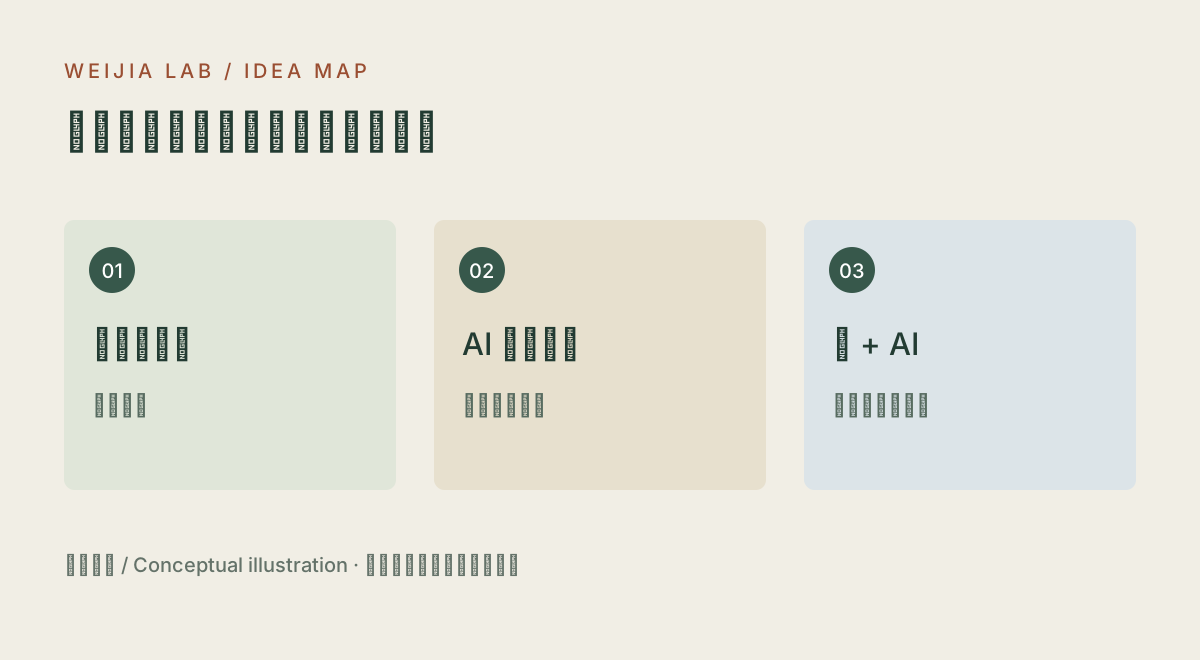
Make the division of work explicit, then compare three baselines: what does collaboration add, and where can it hide mistakes?
2026.11.07 · 7 min read · AI-assisted writing and translation
Letting AI do the task and a person check it sounds reassuring. Yet checking also takes time, knowledge and attention. If the person cannot detect the critical mistake, a final click does not automatically make the answer reliable. To understand collaboration, ask what the person actually changes.
Better than whom?
If someone performs better with AI than without it, the tool helped that person. To claim complementarity, we also need to compare the result with AI working alone. These claims use different baselines.
A 2024 systematic review and meta-analysis covered 106 experiments and 370 effect sizes. Across its tasks, human–AI combinations improved on humans alone on average, but did not outperform the stronger of the human-only and AI-only alternatives on average. Task type mattered. [1] The experiments were published between 2020 and mid-2023; this is not a verdict on every model available today.
The practical requirement is simple: name the comparator when claiming an advantage. Even without outperforming the best individual alternative, collaboration may improve control or meet obligations that require human responsibility. Those benefits should be stated separately.
Same evidence · Same deliverable
HumanIndependent work
AIFixed model and tools
TogetherDefined handoffs
Blind quality review + separate time and cost records
Comparison design, not results. Allocate tasks fairly; do not have one person repeat the same task under all three conditions.
Unpack “you do it, I will check”
The following is a workflow to test, not an established optimum. At each handoff, specify four things: the deliverable, its supporting evidence, who checks the critical judgment, and how to return work that fails.
Consider a fictional product comparison. A person defines the use case and non-negotiable constraints. AI extracts specifications from a shared public evidence pack and attaches sources. A reviewer checks the relationship between the specifications and the conclusions. The decision-maker then approves the trade-offs. Missing information remains missing.
Allocate work according to what can be verified. Deterministic calculations can check unit conversions; aesthetic judgments require actual work and stated preferences. High-cost decisions with weak feedback do not become safe simply because someone reads the output. “People handle values, AI handles facts” is too neat: people misremember, and summaries can conceal value judgments.
Human–AI interaction research recommends making capabilities and limits visible, enabling efficient correction and dismissal, and narrowing service when uncertain. [2] These are design principles, not evidence that this particular workflow works.
Review needs another basis for judgment
Asking the same model to reread its answer may reveal an omission, or repeat the same assumption. A more confident second answer does not establish that the first was trustworthy.
Useful review adds something checkable: the original document, a fresh calculation, an executable test, or a qualified person who forms a judgment before seeing the earlier answer. Measure errors corrected and errors introduced, rather than the number of review rounds.
Repeatedly asking for agreement or disagreement does not create independent evidence. Two answers that share an erroneous source are not two independent confirmations. This is a methodological judgment, not a measured claim about a particular product.
Compare three ways of doing the work
Choose a task that can be checked against public material, such as building a sourced specification table. Define inclusion rules, correctness criteria, serious errors and the smallest useful improvement in advance. Compare a person alone, AI alone, and a predefined collaborative workflow.
Use the same evidence pack and deliverable requirements, with explicit tool and time budgets. Do not ask one person to solve the same question three times in succession: later attempts inherit earlier learning. A formal comparison could randomly assign different participants to conditions using a shared task set. A solo pilot can randomize matched tasks, but task differences remain a limitation.
Where possible, keep reviewers unaware of the condition. Apply fixed criteria to facts, omissions, source support and serious errors. Record elapsed time, human effort, model costs and rework separately. Similar quality with less time supports an efficiency benefit. Faster answers or a higher aggregate score must not conceal more serious mistakes.
On a common scoring scale, improvement over the human-only condition supports human augmentation. Outperforming the better of both individual conditions supports synergy for this task. Keep per-task results and uncertainty. A small pilot with no observed difference does not establish equivalence.
Start with one handoff
No three-condition experiment was run for this essay, and no model scores are reported. The downloadable protocol is a draft to adapt. Start with one task type, one handoff and one primary outcome; a complicated multi-agent system can wait.
A useful collaboration record lets another reader see who added what, how errors were found, and where the arrangement still failed to help. That is when “working together” begins to become a testable claim.