Can the Body Still Recover? Repair, Aging Dynamics and Future Decisions
Maintain repair, detect instability earlier and prepare under uncertainty. Three questions, eight sources and the gaps still to test.
Xian Weijia · 9 Nov 2026 · 8 min read · AI-assisted research synthesis and translation
What would it take for a body to remain repairable? Can dynamical systems help us understand aging? And could signals in language, music and everyday behavior help us prepare for future health and financial needs?
These questions suggest a research path: maintain the capacity for repair, detect a loss of stability earlier, and make decisions under uncertainty. The central question is: could we recognize declining resilience while there is still time to repair?
Three questions, one proposed research path
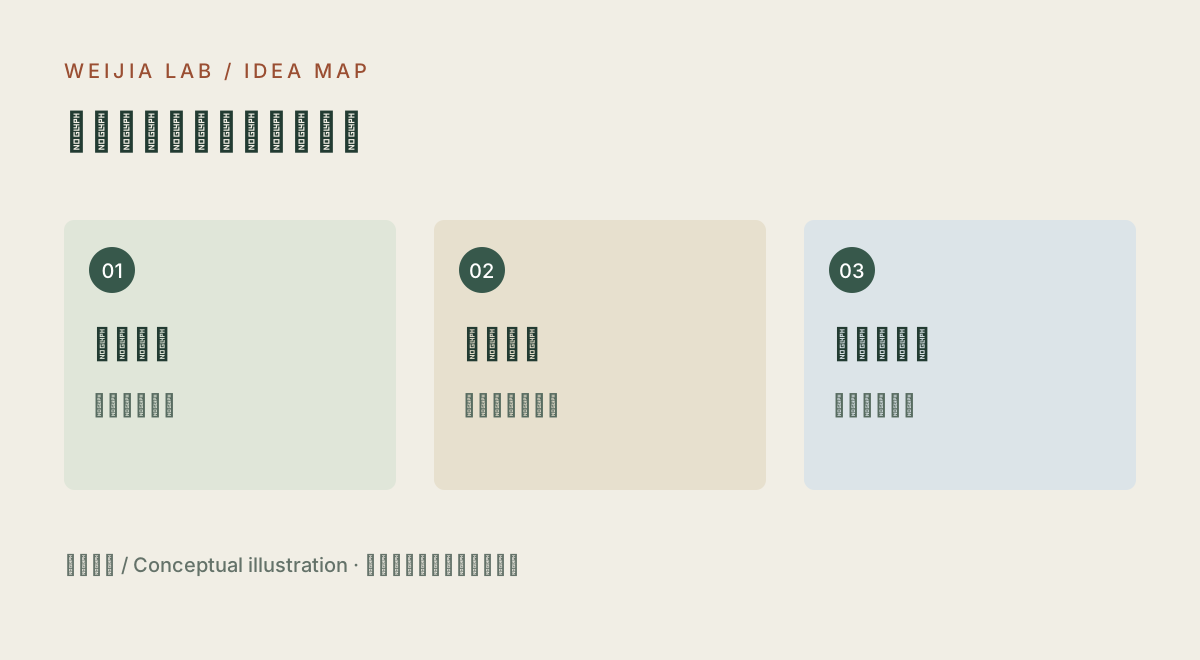
RepairCan function return after damage?
ResilienceHow quickly, and with what reserve?
DecisionsWhich signals help us prepare?
A conceptual diagram, not a validated causal chain. Each step needs its own evidence; a finding at one step cannot validate the next.
1. After one repair, can the body handle the next?
A more concrete goal than keeping every measure permanently young is to restore function after damage while preserving the repair system’s capacity for another challenge.
That goal involves at least four problems:
Remove or repair accumulated damage.
Maintain systems involved in repair, including stem cells, immunity and blood vessels.
Integrate repaired cells into the right places and functions.
Stop repair at the appropriate time, avoiding uncontrolled growth, cancer and fibrosis.
These are research conditions synthesized with reference to the Hallmarks of Aging review, not a proven formula for indefinite life. The brain adds another difficulty: replacing cells does not by itself preserve memory and identity.
There are experimental clues to local repair. A 2020 mouse-retina study reported improvements in some visual functions following partial reprogramming. Local results in mice remain far from establishing safe, lasting and repeatable repair throughout a human body.
Progress therefore needs to be assessed through restored function, durability and performance after subsequent damage, rather than a one-time improvement in a marker.
2. Can we study recovery, rather than only a snapshot?
A resting measurement describes a state, but not necessarily how the body will respond to a challenge. A dynamical-systems perspective asks whether it returns, how quickly, and with how much capacity left.
A 2021 human longitudinal study analyzed a blood-derived state indicator and physical activity, finding longer recovery times for fluctuations with age. This is a statistical property of indicators, not a direct measurement of how long an individual takes to recover from illness. The paper’s extrapolated lifespan limit is not an established human ceiling.
A more direct intervention was tested in another organism. A 2023 yeast experiment redesigned a regulatory circuit to oscillate between two aging pathways. Replicative lifespan increased by about 82% relative to wild-type controls. It shows that changing a system’s dynamics can alter aging in a particular organism. The percentage cannot be transferred to humans.
A testable question follows: among people of the same age and similar resting measurements, could recovery curves after a safe, standardized perturbation predict future disability better than a single measurement?
This is a direction for professionally designed research, not a recommendation to stress-test yourself. Perturbation choice, sampling frequency, measurement stability and added predictive value all need investigation.
3. How far can signals in language reach?
The 1996 Nun Study report examined early-life autobiographies in 93 participants and linked idea density to cognitive outcomes decades later. An association in a small, unusual population does not establish an individual’s future disease probability.
Later studies move closer to AI applications. A 2020 written-language study identified signals associated with later Alzheimer’s disease in picture descriptions from a particular cohort.
A 2024 study analyzed 166 people who already had mild cognitive impairment, predicting progression to Alzheimer’s disease within six years with about 78.5% accuracy in its best model. It combined neuropsychological interview transcripts with information including age, sex and education. This was not prediction from voice timbre or everyday chats, and performance does not establish generalizability to the wider population.
Language is worth studying, but tasks, education, first language, mood and writing habits can affect it. Separating two groups within a cohort and producing a reliable risk estimate for a new individual are different achievements.
The same boundary applies to music. Even an association between musical engagement and cognition would not let us infer health decades ahead from someone’s playlist. Taste, training, performance and social participation are different variables, not one interchangeable “music health score.”
4. When does prediction actually improve a decision?
A US study found that Medicare beneficiaries later diagnosed with dementia were more likely to have delinquent credit payments years before diagnosis. Six years beforehand, the rates were about 7.7% and 7.3%, an absolute difference of just 0.4 percentage points.
This group difference cannot diagnose a person who misses a payment. Nor does predicting a health risk tell us which asset to buy.
More defensible applications to investigate include backup arrangements for bills, fraud protection and funding scenarios for care. Whether a model improves those preparations needs separate validation. Unvalidated health inferences should not automatically trigger investment decisions.
5. Narrow the idea to a question we can test
A starting point could be:
Can repeated language tasks, collected with informed consent, improve prediction of cognitive change over the next 3–5 years in older adults, beyond existing clinical information?
This remains a proposal. Begin with replication on appropriately authorized data, define baselines, test sets and evaluation criteria, then validate across languages and regions. Research involving participants also needs appropriate ethics review, informed consent and privacy protections.
Even if health prediction works, improved financial preparation is a second research question. Prediction error, anxiety from false alarms, harm from missed warnings and actual decision outcomes belong in the evaluation alongside accuracy.
Everyday chat records cannot directly establish a person’s long-term disease probabilities. No private health records are being presented here as public evidence.
The three questions converge on a direction: recognize how the capacity to recover is changing before that capacity is exhausted. It is specific enough to investigate while leaving room for answers we do not yet have.
Adapted from a discussion of repair, aging and future decisions. References and key figures checked on 9 Nov 2026; cited experiments have not been independently replicated here. This is a topic synthesis, not a systematic review.