Knowledge for the Next Person: An Index Open to Correction
Six public examples, their limits, and a practical way to preserve and revise them.
Xian Weijia · November 12, 2026 · v1.0 · 10 min read
To help the next person reach further, leave steps they can inspect: where a question came from, how far the evidence goes, what went wrong, and how to continue.
This index selects six examples from already public work. The reusable methods include fixing evaluation rules, retaining failures, tracing retellings to their origins, and writing a question clearly enough for someone else to pursue it.
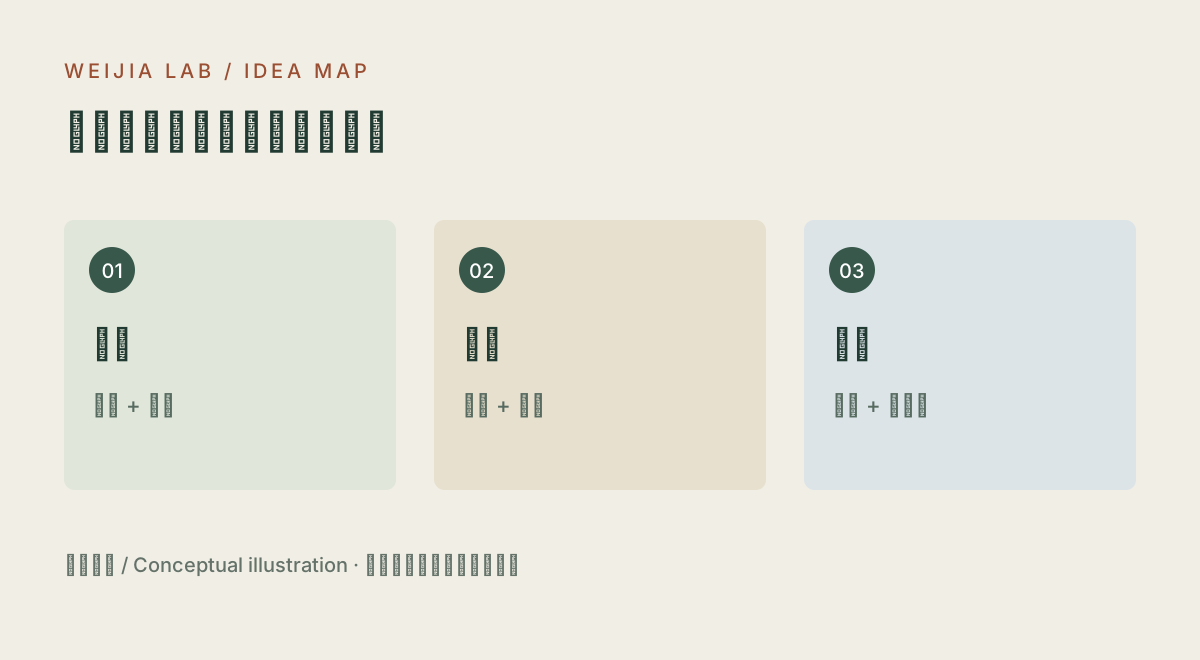
PreserveKeep the claim and its evidence.
CorrectRetain counterexamples and revisions.
Pass onLeave a usable next step.
A conceptual workflow, not a measured result.
Six records worth carrying forward
K01 · Synthetic testing tool; no reported model runs
Turn AI errors into tests
New test prompts, failure conditions and acceptance criteria let others check the same failure mode in another setting.
Limits:Ten cases are not ten independent incidents or a model leaderboard. The rubric itself needs validation.
Next check:Fix model versions and settings, retain full outputs, record blinded judgments and disagreements, and reserve unseen cases.
K02 · Bounded historical tests and negative results
Keep methods that did not pass
The Bitcoin study preserves rules, data, code and results from four specific mechanism tests that did not meet its adoption criteria. Such records can help others avoid repeating the same mistake.
Limits:The tests overlap in data and market regimes. They do not establish that Bitcoin is unpredictable or that all related indicators are useless.
Next check:Rerun the frozen materials and check time splits, target definitions and matched baselines. Specify new rules before examining new data.
The CATL article retains unsupported fixed-lag hypotheses, its October 27 text and the evaluation rules appended on November 6. The reusable contribution is the visible path of revision.
Limits:Comparable historical samples are scarce. This index does not update the market view or promote an old observation window as a reliable forecast or trading advice.
Next check:Date new evidence separately from the original text. Evaluate at the planned endpoint and preserve old rules with reasons for changes.
K04 · Research protocol; no established collaboration gain
Make collaboration testable
The human–AI collaboration article proposes comparable human-only, AI-only and combined conditions and provides a downloadable protocol. A protocol can be continued before results exist.
Limits:The protocol is a proposal. A finished webpage is not a completed experiment, and synergy is not guaranteed.
Next check:Fix tasks, evaluation criteria and resource conditions before comparing the three baselines. Retain errors, time costs and null results.
K05 · Literature synthesis and a learning proposal
Distinguish understanding now from learning that lasts
The AI learning article distinguishes immediate performance, delayed retention and transfer, and frames “try first, ask for help later” as a testable personal strategy.
Limits:This is a published interpretation of literature, not an independent replication. Different populations and tasks cannot be collapsed into a universal conclusion.
Next check:Check the original studies, controls and timing. For a personal comparison, specify delayed testing and scoring in advance.
K06 · Published engineering repair record; synthetic cases
Ten retellings are not ten sources
The fanshi-research validation record documents a flaw: ten renamed, manually confirmed AI retellings kept a conclusion “supported” after the original was removed. The repair treats AI and reposts as trace nodes and groups them by provenance.
Limits:The public document was checked for this article; its tests were not independently rerun. Synthetic tests and a registry do not authenticate real-world evidence or validate financial performance.
Next check:Trace claims to their origin and reassess after removing an origin group. Preserve “unknown” rather than filling the gap with more retellings.
A conclusion travels easily; its conditions often do not. Keep a short record with:
Claim: Say exactly what is proposed. Do not turn “may help” into “has been proven.”
Source: Keep the original author, link, date and locator. Trace reposts and AI summaries through the same provenance chain.
Evidence type: Distinguish observations, experiments, replications, literature interpretation, experience and proposals.
Conditions and limits: Who, when and which task? What alternative explanations remain?
Counterevidence and next test: What would overturn the claim, and how can it be checked?
Version: What changed, when, why, and where can the previous statement be found?
The JSON download contains all six records and a blank template for offline use. It contains no raw private conversations and grants no new license to linked materials.
Version 1.0 · November 12, 2026. This portable text file does not automatically verify sources or receive revisions.
How should an error be corrected?
Identify the specific claim and provide a checkable source or counterexample.
Distinguish a wording error, new evidence and a failed conclusion. Mark major unresolved issues or withdrawals clearly.
Record the old statement, new statement, reason and date. Do not silently erase a failed result.
Check dependent articles, data and code, and note the consequences where needed.
History also has limits. Privacy violations and material that should not lawfully circulate should not remain public merely for version completeness. A correction notice can preserve accountability without retaining harmful content.
Readers can use the Lab’s existing contact section to report a specific issue. This page adds no comment system and promises no automatic review or update schedule.
Ways to preserve knowledge beyond a blog
These are options, not actions already taken. This publication creates no archive account, deposits nothing in a third-party repository and grants no new license.
Downloadable, open formats: Use TXT, Markdown or HTML for prose and CSV or JSON for structured records. Include field descriptions, units, versions and reading instructions, plus necessary media.
A version-controlled repository: Keep methods, code, tests and corrections together. Maintain a separate backup rather than relying on one account.
A versioned research archive: Once rights and publication scope are clear, consider a repository with versioning and persistent identifiers. An identifier aids discovery; it guarantees neither truth nor permanent availability.
Multiple recoverable copies: Keep local and off-site copies, record checksums and test restoration. Match encryption and access instructions to the material’s sensitivity.
Tutorials, courses and reproducible exercises: Teach the implicit steps, with practice and failure examples. Independent reuse is a stronger sign of transfer than page views.
Oral histories, manuscripts and institutional collections: Preserve context and experience with dates, editorial attribution and uncertain recollections clearly marked. Address other people’s privacy and usage rights first.
The blog invites reading; sources and data enable checking; code and exercises enable trying; versions and backups enable later retrieval. Completing this chain for one article is a useful start.
Revision history
v1.0 · November 12, 2026: Created six public-source records with evidence categories, limits, next steps, a blank template and a correction process. No new empirical results. Linked pages and repository documents may change; check their dates as well.